
Newham Hospital Art Trail
Cara Nahaul, Medicinal Flora and Canopy, 2020, Newham Hospital
Vital Arts, working with Creative Newham and the University of East London, is launching a new wellbeing art walk for all staff at Newham Hospital. The walk has been developed with input from staff and is led by visual artist and creative producer Bala Ayyappan.
The route is a gentle walking trail around the hospital grounds designed to encourage movement, get connected with the environment and help you discover more about the artworks around the hospital. There are also plans to adapt the walk for patients in the future.
Things to know before starting the Art walk
Start anywhere, anytime - You can begin from any location in the hospital and adapt the activities to nearby artworks.
Flexible and self-paced - There are 4 main activities with additional creative prompts. Try activities in any order, during short breaks or longer walks.
Do it your way - You can take part on your own or with colleagues as a small group.
Share your feedback - Please complete the pre-trail feedback form here before you start and find the post-trail form at the bottom of this page.
Enjoy the experience - There are no right or wrong answers. This is about noticing, reflecting, and enjoying a moment for yourself.
This Map will help you spot the artworks located along Newham Hospital Street, between the West Wing entrance and St Andrew’s Wing entrance.
Start our self guided Art Walk
Look and Move
How this works
Find an artwork in or around Newham Hospital, wherever you are. Take a moment to stop and look at it.
Notice a shape that stands out to you, maybe a curve, a loop or a zigzag. Slowly trace the shape in the air with your hand, following its path. If you feel comfortable, follow the shape with your body. You might take a curved step, turn gently, or sway.
You can also keep it simple by following the shapes with your eyes.
There is no right or wrong way to do this. Small movements, or even stillness, is enough.
Tip: At Floor 0 (zone 1 foyer) and on Floor 1, spot the shapes and patterns in Lauren Godfrey’s immersive artwork. Look up and around for interesting shapes and patterns to guide your movement.
On the Floor 1 (zone 2), notice how the bold shapes in Emily Floyd’s Abstract Labour encourage you to move and explore.
If you would like to explore further, head back to the ground floor and continue to the Orthopaedic Centre (BHOC) to discover Rhys Coren’s vinyl wallcovering and framed prints.
Colour Hunt
Colour Hunt is a simple mindfulness activity. It is about paying attention by gently focusing on one thing at a time. There are two creative prompts, Capture a Colour and Mindful Colouring.
How this works
Capture a colour
Start by looking at an artwork and choosing one colour that stands out to you.
Next step is to move around hospital hunting for your chosen colour. You can take photos if you like using your phone, or simply notice the colour as you go.
As you move through your day, look for the same colour in everyday places such as walls, signs, furniture or lights.
If you use Instagram, you can make a quick collage of the photos you captured and tag the Vital Arts page. we would love to see your creations.
Mindful colouring
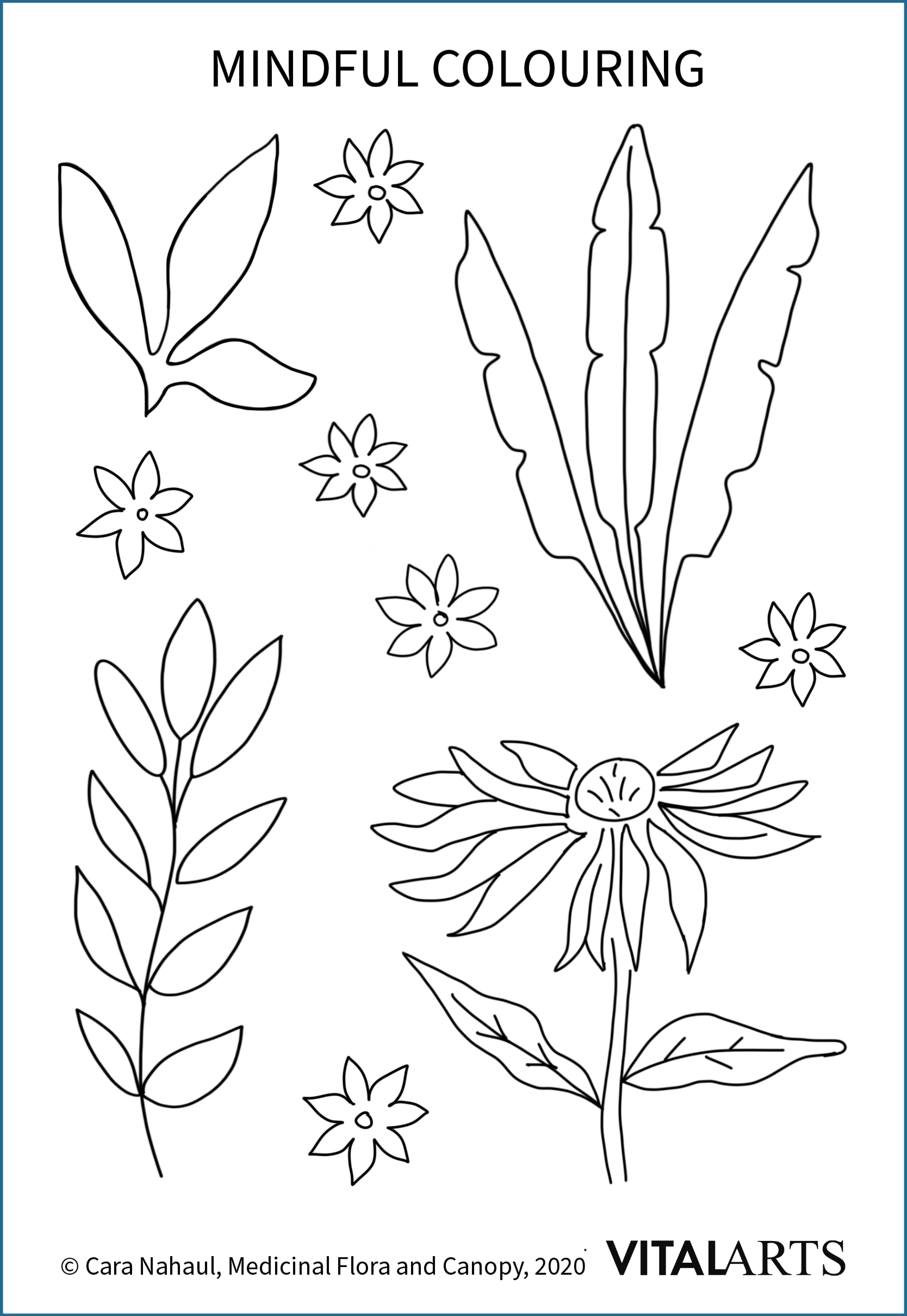
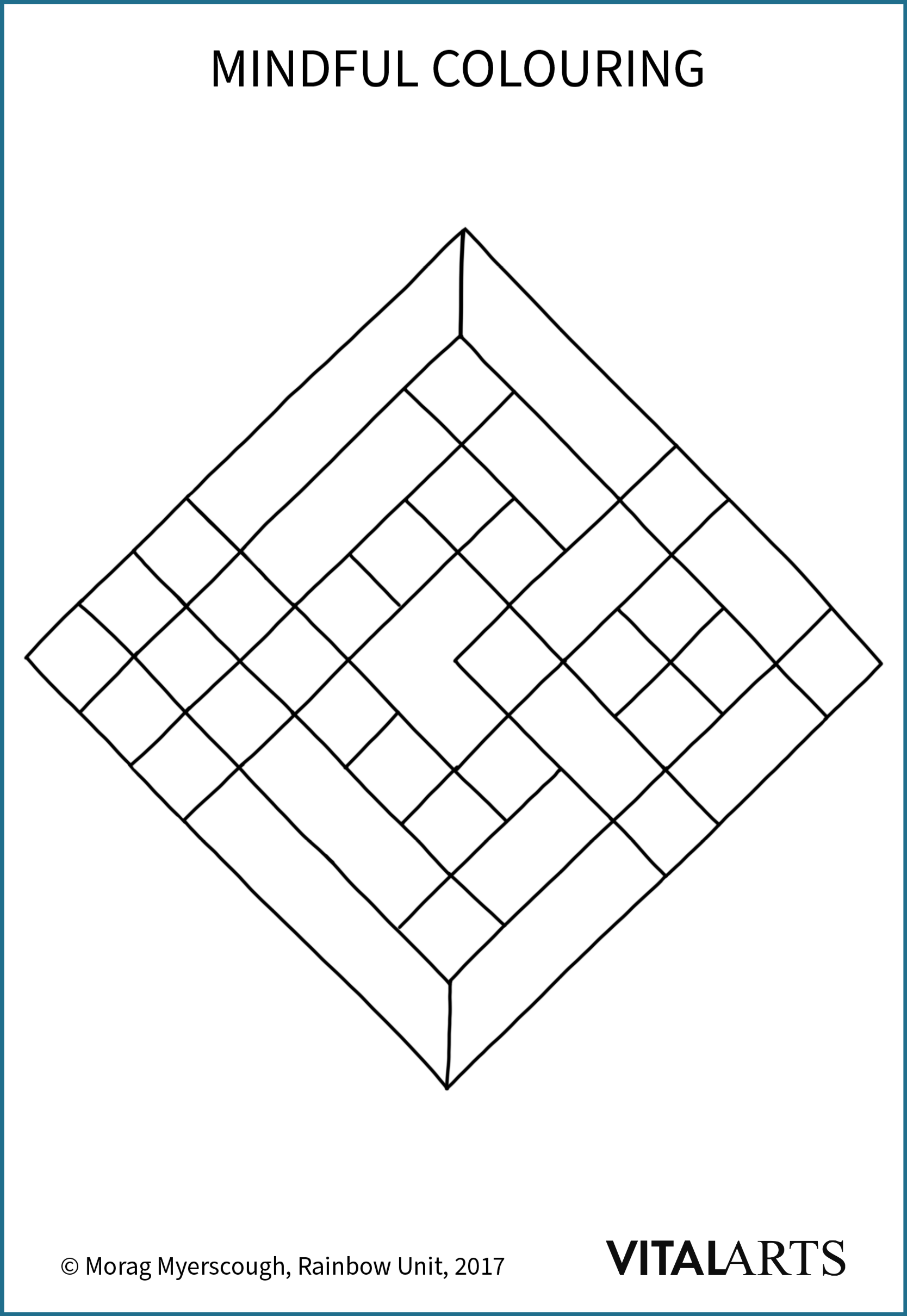
Mindful colouring for adults is a calming activity that encourages you focus on the present moment and engage creatively.
You can colour in the shapes or add your own patterns. Paper prints with simple outlines are available in the Wellbeing Space, or you can colour digitally on your phone if you prefer.
Go Green
Go Green is a set of gentle, nature-based activities designed to encourage you to connect with green spaces. World Health Organization (WHO) reports that green spaces provide psychological relaxation and stress reduction. Vital Arts have commissioned a wide range of artworks based on green spaces and the natural world. Scroll to bottom of the page to see.
How this works
Go Green includes three optional prompts that can be done independently, for just a few minutes or longer, depending on your time and comfort level.
Find any green space in the hospital such as the Healing Garden, staff garden, or a courtyard using the map and use this space as a starting point for the activities.
Leaf Breathing
Stand or sit comfortably at any green space and look up into the canopy. As you breathe in, rest your attention on one leaf.
As you breathe out, let your focus move to another leaf. Keep going as one breath, one leaf.
If the tree has no leaves, follow the line of a branch instead, letting your breath travel along it from trunk to twig.
Stay for a few breaths, or for as long as you need.
You might also notice the different shades of green or brown in the canopy to guide your focus.
Nature Mandalas
Mandala art originates from ancient spiritual traditions in Hinduism and Buddhism, where it is used as a tool for meditation, focus, and self-reflection. The word “mandala” means “circle” in Sanskrit, symbolizing unity, balance, and the interconnectedness of life.
Take a few quiet minutes in a green space and look around for what’s already there such as fallen leaves, petals, small twigs, stones.
Choose an empty space of ground and start placing them into a simple shape or pattern. It might become a loose circle, a line, or something symmetrical.
When you are ready, step back and notice the moment, then leave the pieces where they are to return to nature.
If you want, you can take a quick photo before you go just as a quiet reminder of the pause you gave yourself.
There is no planning needed. You can move things around, add or remove pieces, or stop whenever it feels enough. It is less about making something good and more about letting your hands slow down and your attention settle.
Patterns of Nature
Take a slow walk inside the green space.
As you walk, start to notice the patterns that show up naturally: the symmetry of leaves, repeating shapes in petals, spirals in seed heads, or the branching lines of trees and plants.
When something catches your eye, pause for a moment and observe. If it feels helpful, carry a small notebook and pen and loosely sketch the shapes or lines you see.
Or use your phone to gently zoom in and take a photo or short video of a pattern that feels calming.
This isn’t about getting a perfect image or drawing, just giving your mind a different kind of focus for a few minutes.
Deep Dive
Spy, Think and Tell
Spy, Think and Tell are activities designed to help you think more deeply about the artworks around the hospital.
How this works
The activity includes three optional prompts which can be done individually, or in a small group. You can use the map to find the artworks in hospital.
Spy
Explore artworks across both floors and spot the objects hidden within them.
To help you get started, a clue card has been provided for each floor.
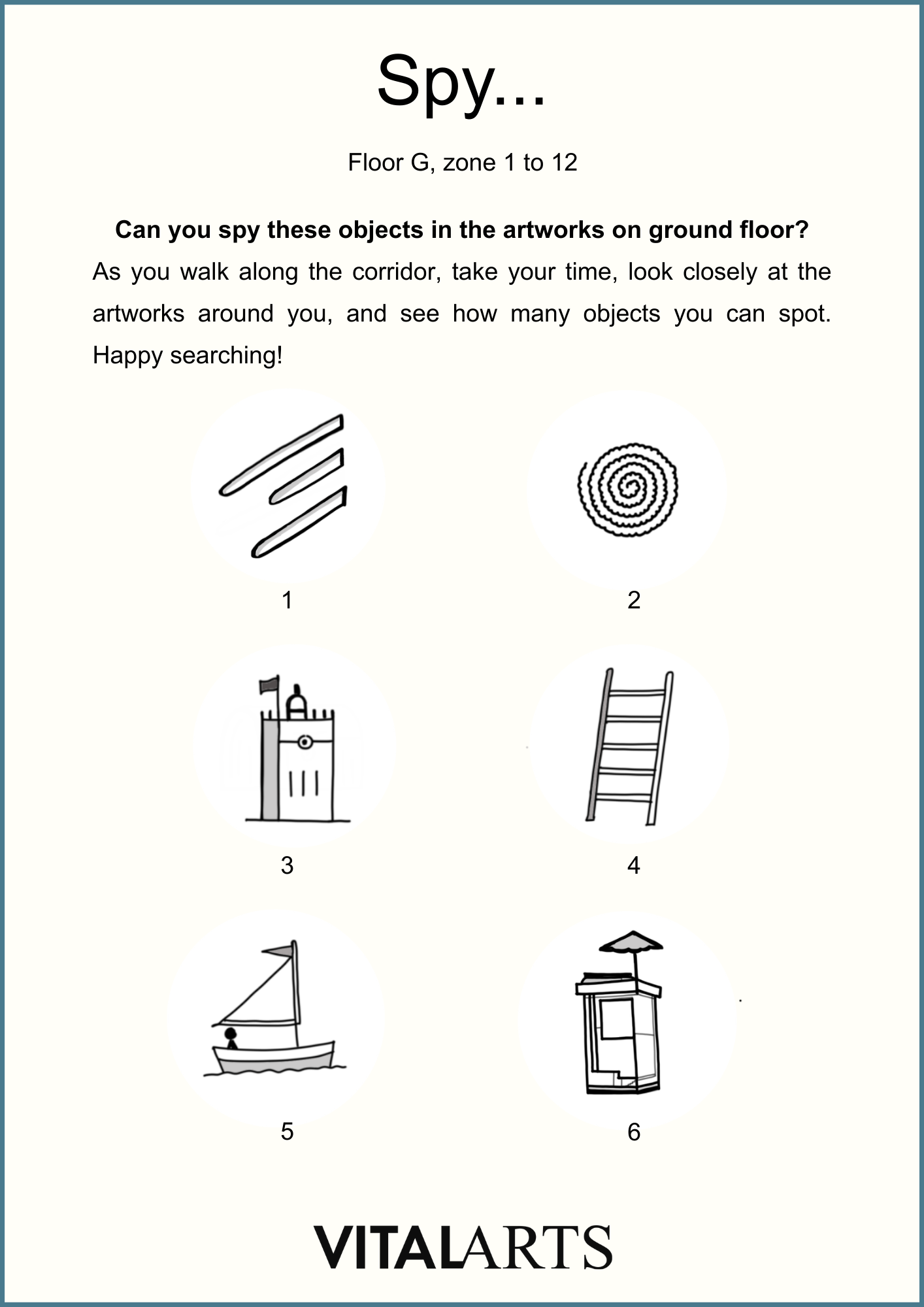

Find the answers for Spy activity here: Answers.pdf
Think
The clue cards below include the name of an artist and some riddle-style or thought provoking questions.
The questions are designed to get you looking closely, thinking creatively, and imagining your own answers. There are no right or wrong responses.
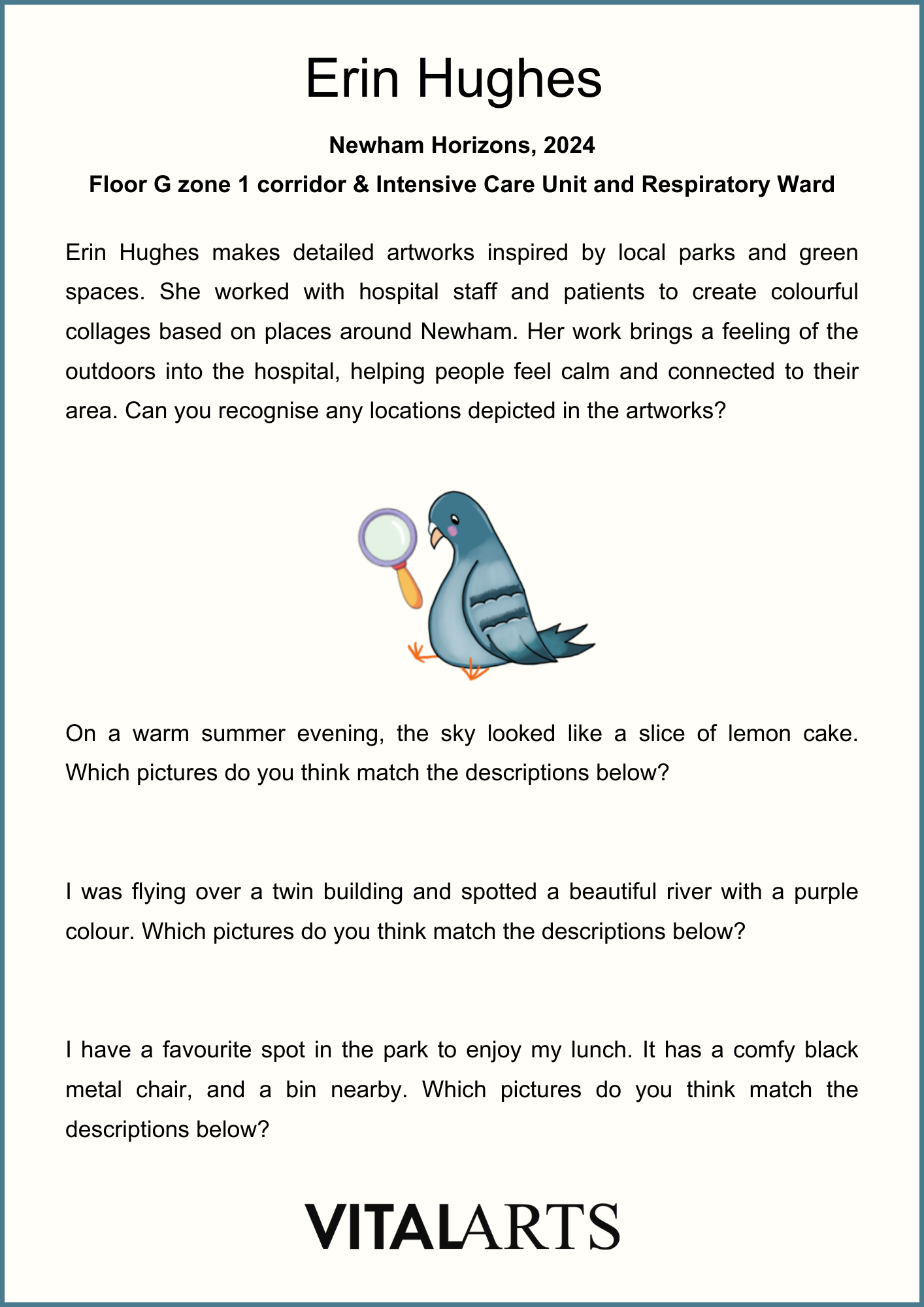
Tell
Take a moment to look at one or more artworks and let your attention settle on a small detail such as a colour, shape, texture, or element that catches your eye. From this, you can quietly form a story or thought in your mind.
If you wish, you are welcome to write it down on paper or make a note on your phone.
To help you get started, a set of artworks with creative prompts are provided here.
Thank you for completing our Self-Guided Art Trail!
We hope you enjoyed the experience. We would love to hear your thoughts. Please take a moment to fill out our post-trail feedback form and let us know about your experience here.
If you have any questions, comments, or suggestions, feel free to submit them below or email jo.knox@nhs.net. Your feedback helps us make future trails even better!


Partners